
How to Set Up a Proxy in Shadowrocket on iPhone & iPad
Table of Contents
Key takeaways
Shadowrocket is a widely used proxy management app for iOS.
The app allows you to configure multiple proxy profiles easily on Apple devices.
The setup process involves adding a server with your proxy credentials.
Shadowrocket supports multiple proxy protocols and has a built-in feature to test proxy connections.
Shadowrocket is a popular proxy management app for iOS devices, allowing users to easily connect with their proxies. The app supports different proxy protocols, like SOCKS5, HTTP, and HTTPS, so users can use their preferred proxies.
This guide will walk you through the entire process of how to get the Shadowrocket app and add anyIP proxies to your iPhone, iPad, or any other iOS device.
💡 To follow this tutorial, you’ll need a few requirements:
An Apple device
Shadowrocket installed
A proxy account. Enjoy 5GB of data with our Micro Plan with anyIP
Your anyIP connection details:
Server: http://portal.anyip.io
Port: 1080
Your anyIP username and password
Quick setup: In Shadowrocket, tap +, choose your proxy protocol, enter portal.anyIP, port 1080, and your username and password, then tap Save to activate your proxy connection.
How to set up a proxy on iOS using Shadowrocket
The process of adding anyIP proxies to your Shadowrocket app is straightforward and only takes 5 steps.
Step 1: Download and open Shadowrocket
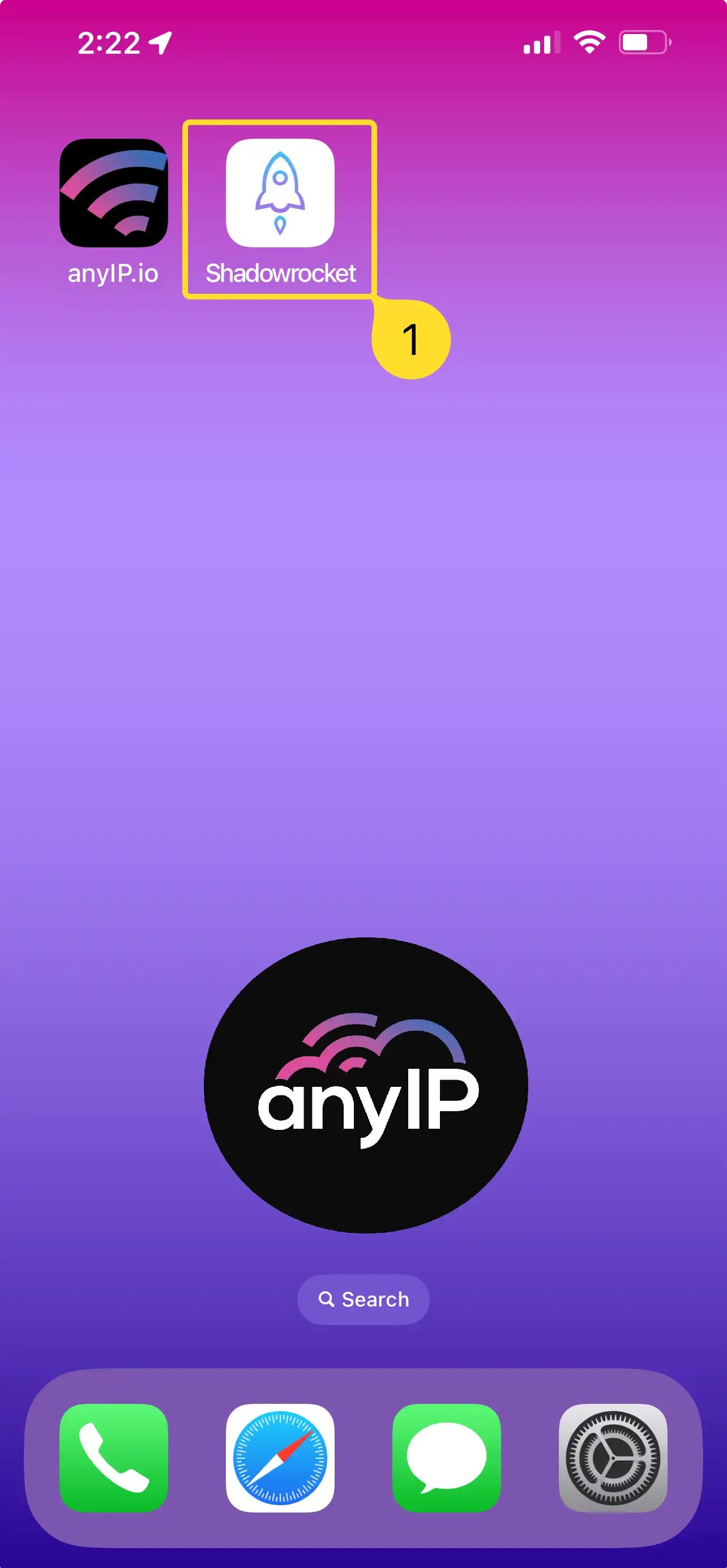
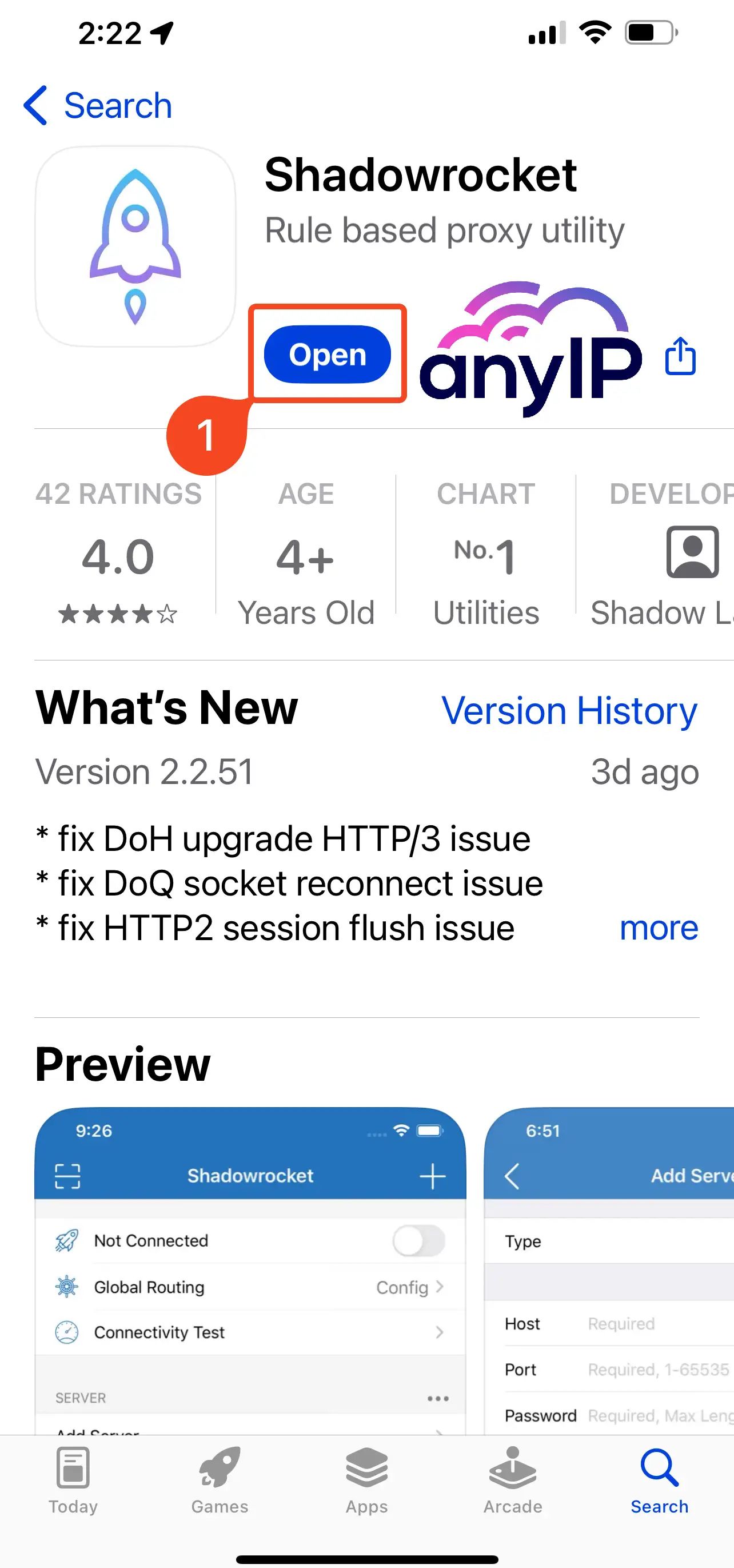
For starters, go to the Apple App Store, look for the Shadowrocket app, and download it. Once it’s installed on your iOS device, open it via the App Store or search for the app on your phone. Note that Shadowrocket is a paid app. The current price is $2.99 in the US (September 2026).
Step 2: Create a new server
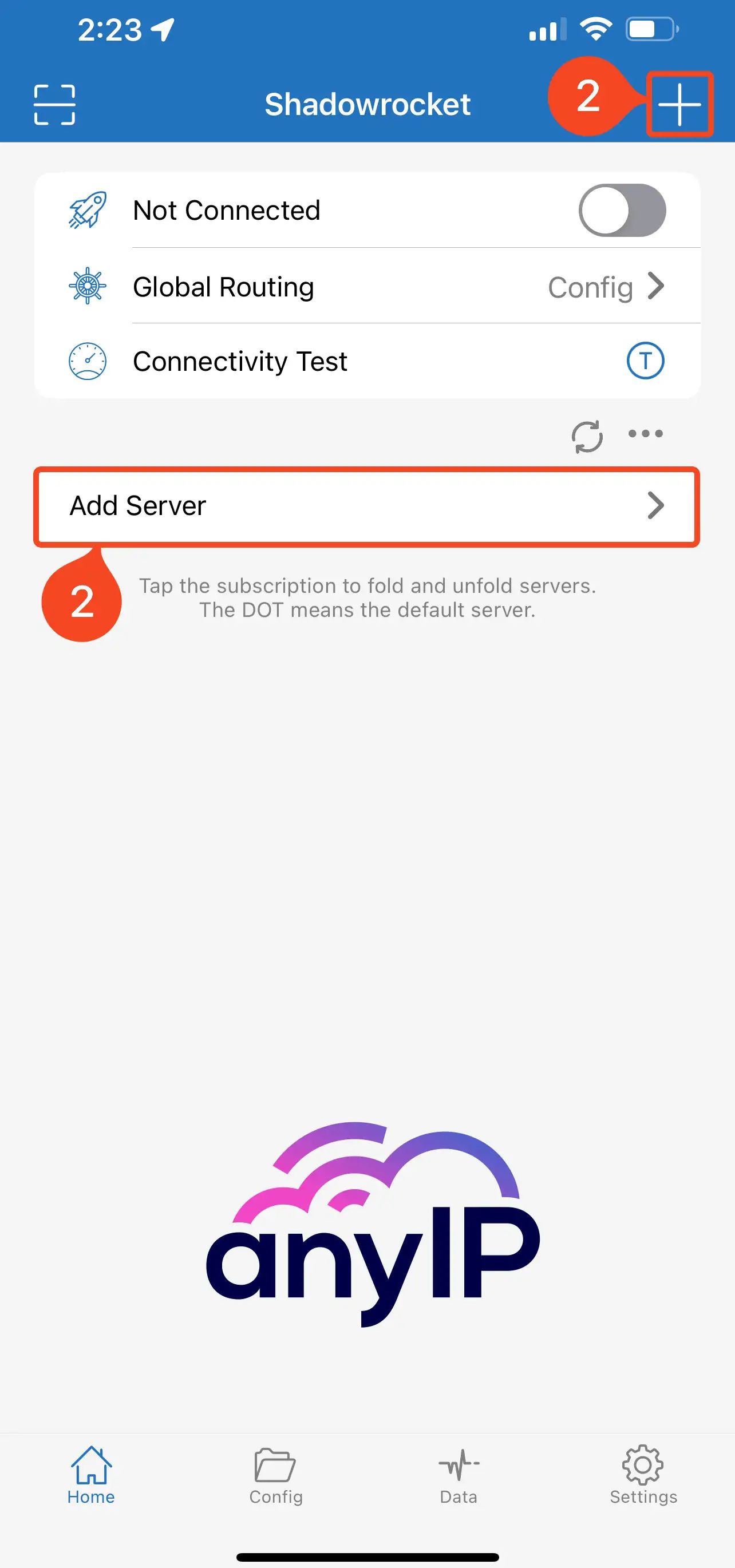
After you open the app, you’ll notice several elements. The initial window shows a connectivity test and whether you’re connected and have global routing. Go ahead and tap on + to start creating a new server.
Step 3: Configure your proxy
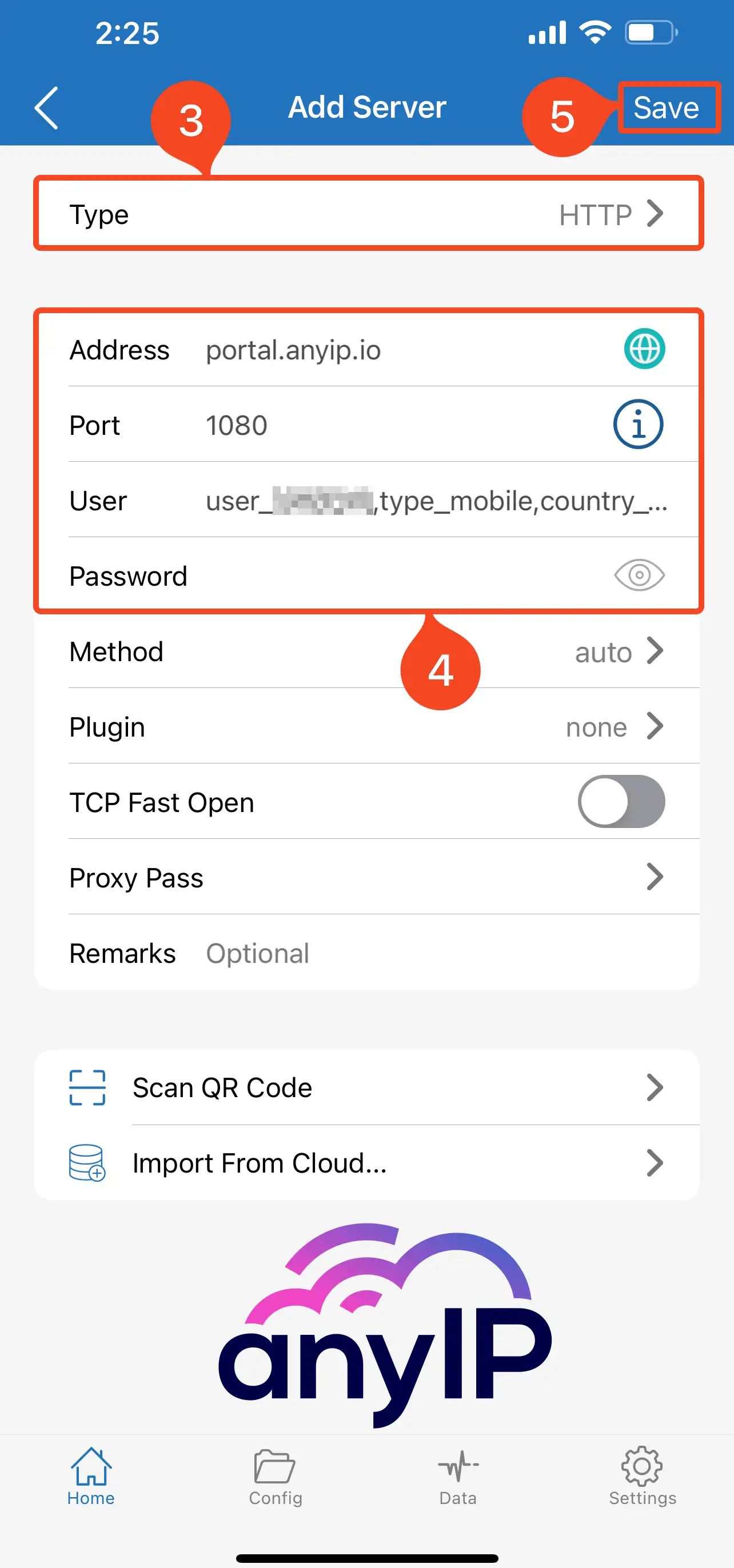
In the server creation window, you’ll need to add your proxy details to configure your server.
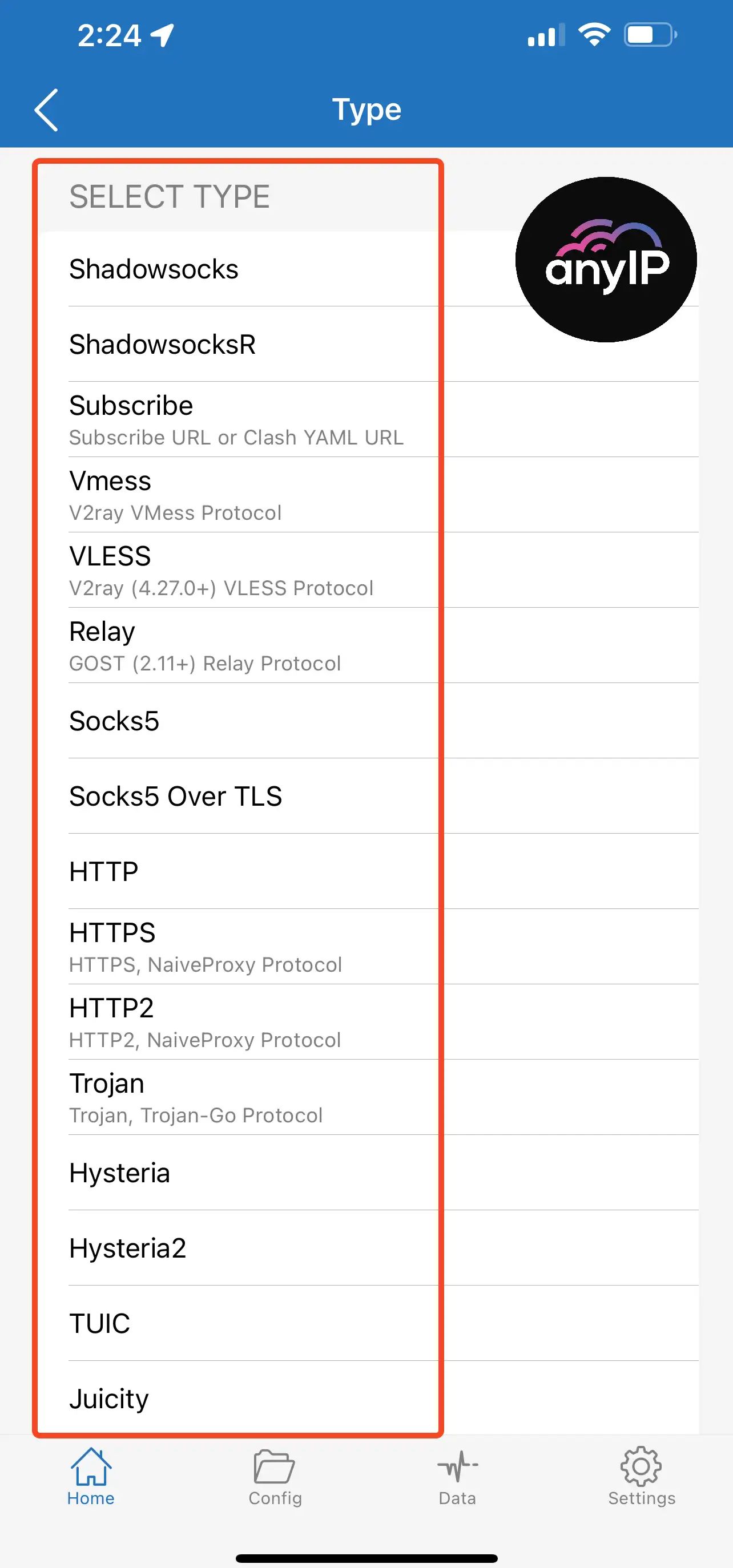
Select the protocol your proxy uses. For this guide, we've selected HTTP.
Copy your proxy details and paste them in the appropriate fields. For this guide, we’ll be using mobile proxies (to access your proxy credentials, you just need to go to the anyIP dashboard and select the proxy you want to use).
Address (portal.anyIP)
Port (1080)
User (username)
Password
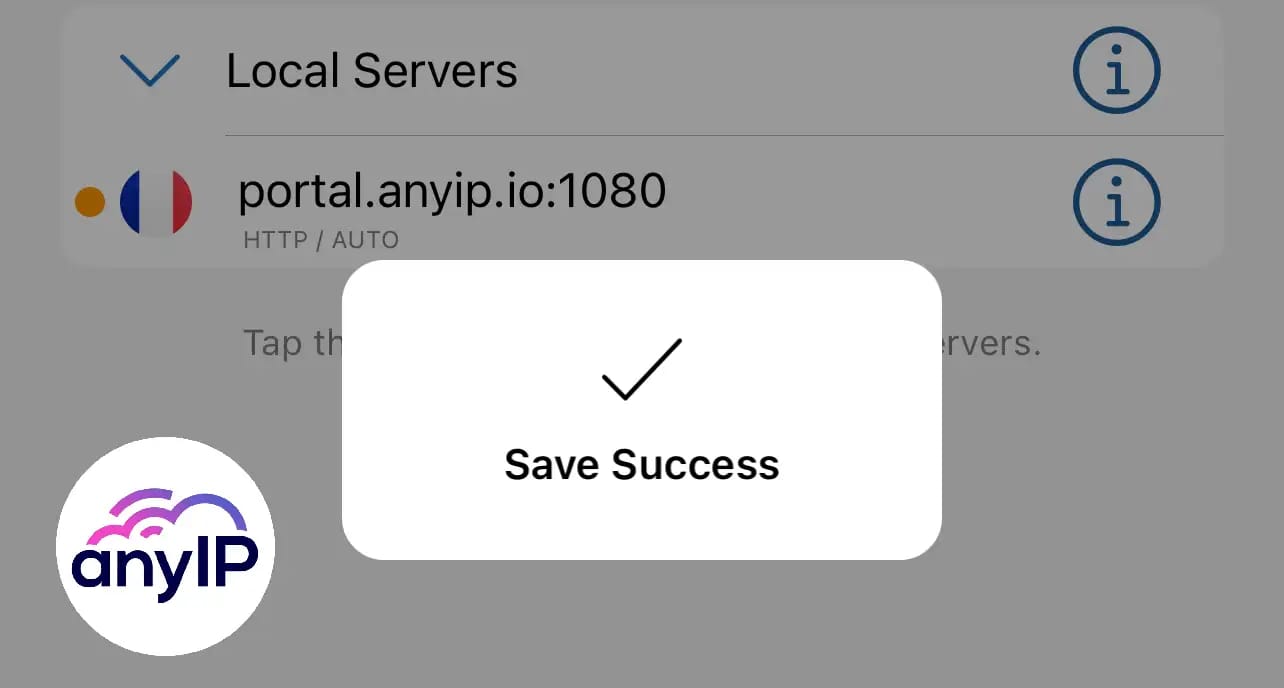
Double-check all information to make sure everything’s correct and then tap Save.
💡 Shadowrocket supports multiple proxy protocols, including SOCKS5, HTTP, and HTTPS. This makes it particularly flexible if you want to test different proxies without switching to a new mobile proxy management app.
Step 4: Activate your proxy connection
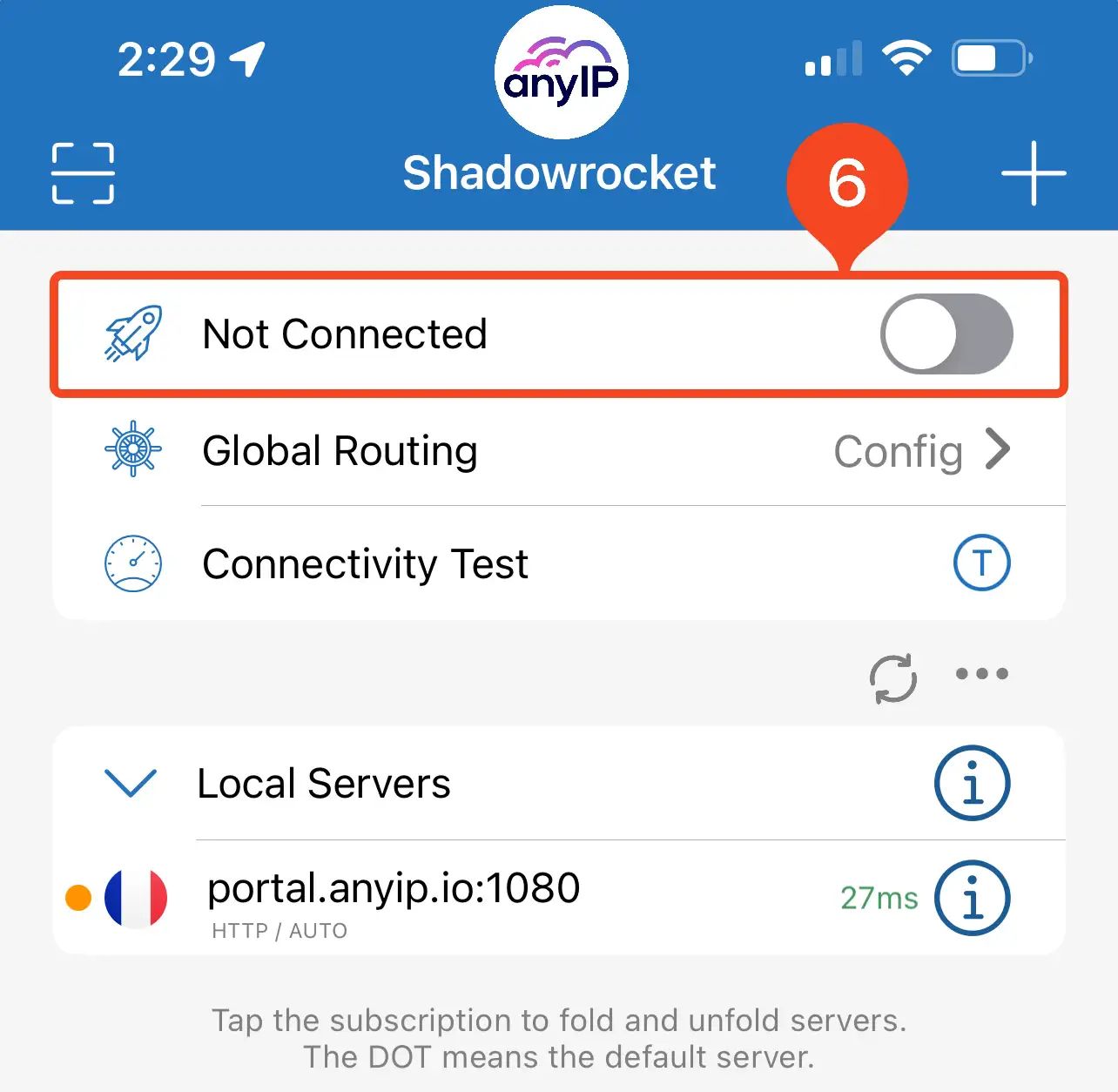
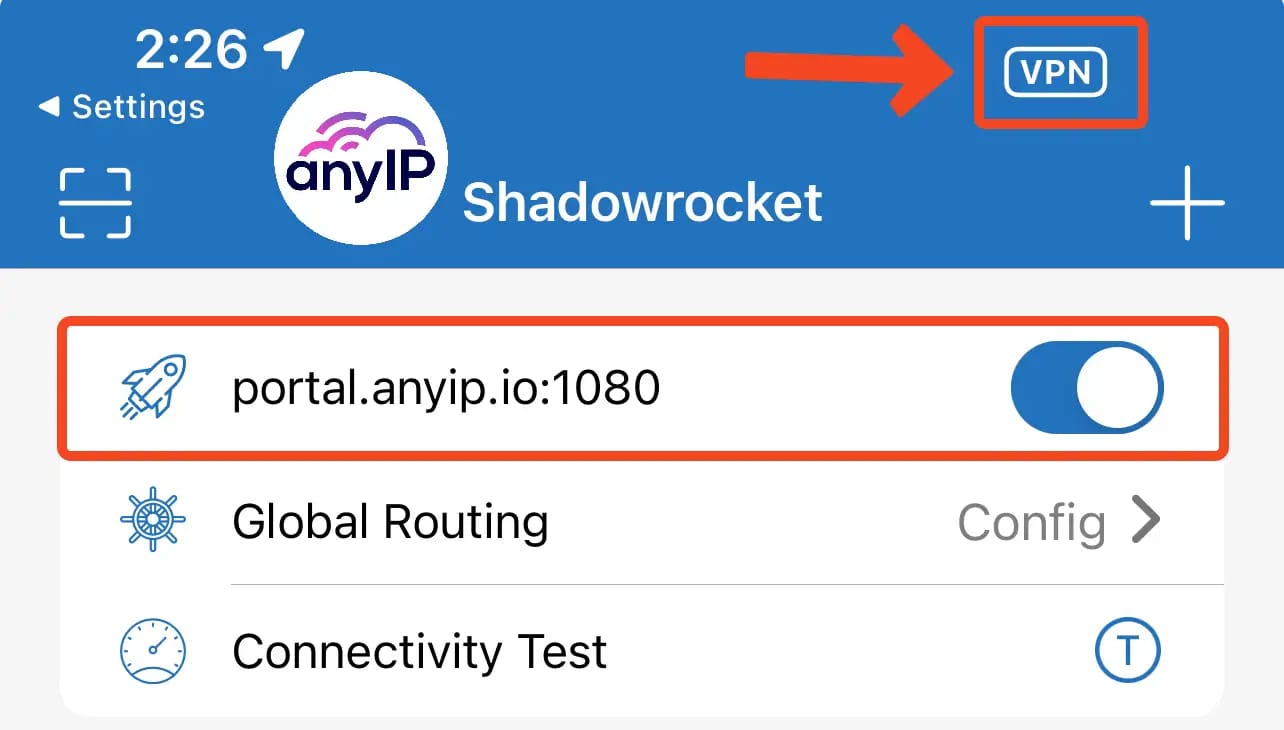
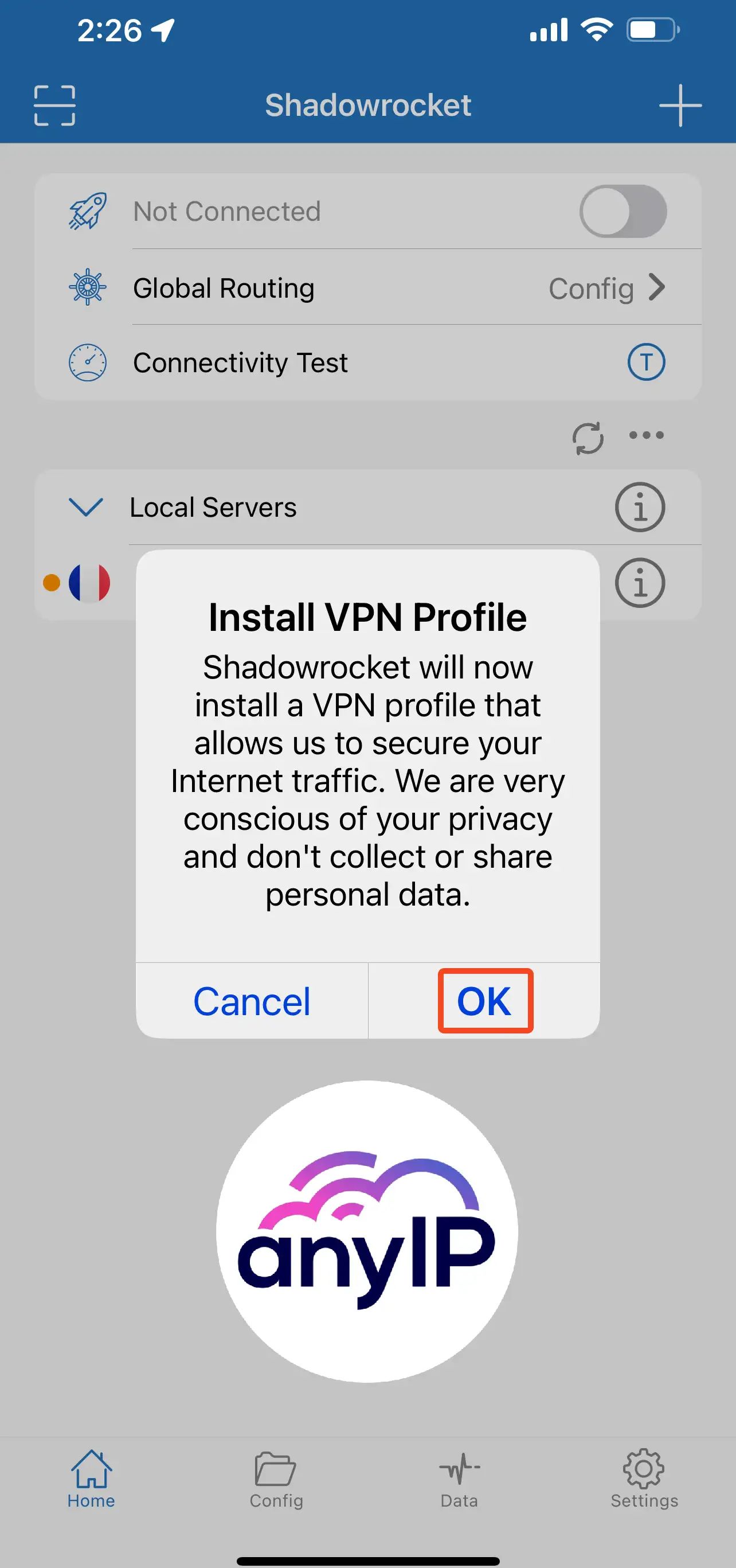
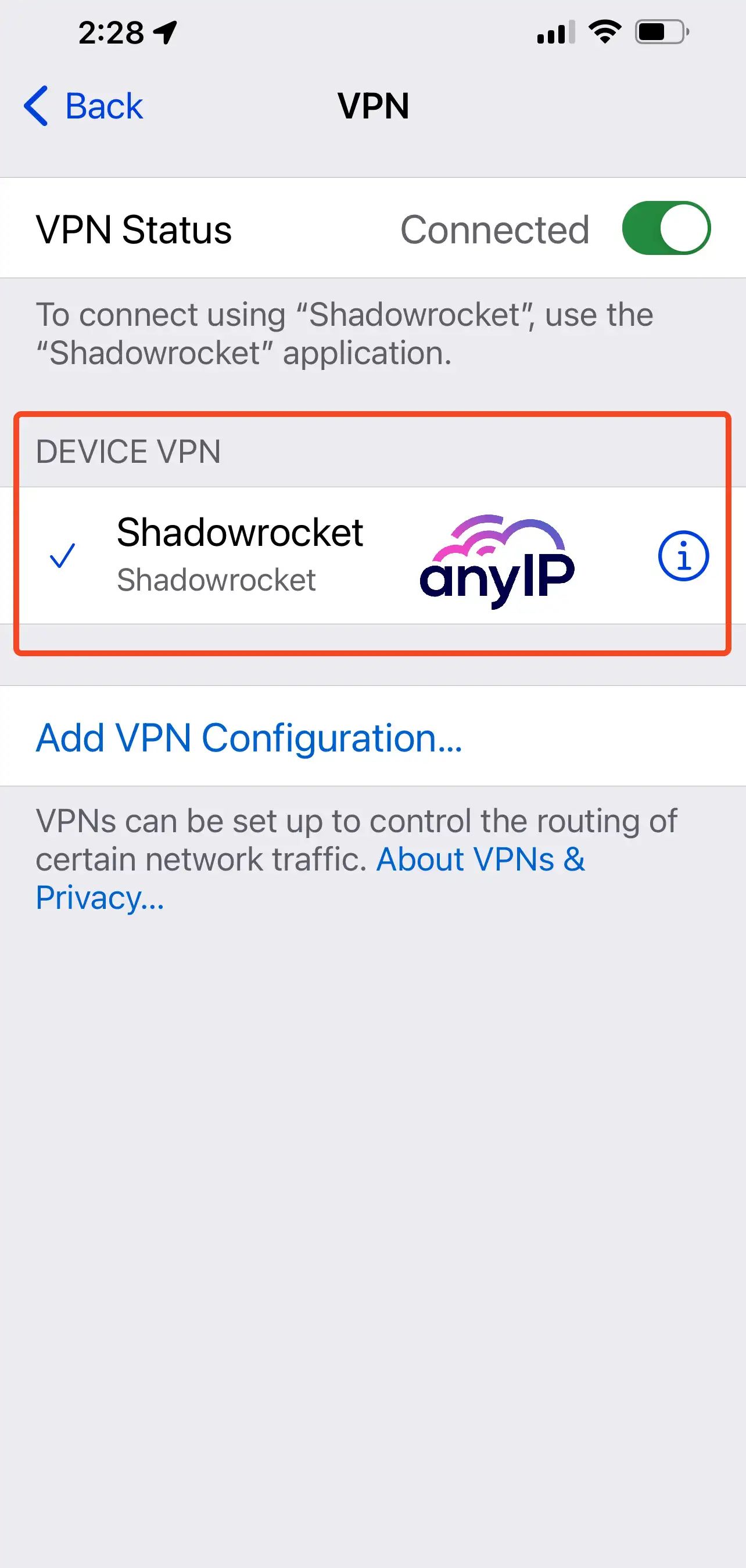
Now that you’ve configured and saved your proxy server settings, tap the Not Connected toggle to activate your proxy connection. You should now see a VPN icon appear on the top bar of your phone. This is because Shadowrocket operates on Apple's Network Extension framework.
|
|
|
Step 5: Proxy connection test
While Shadowrocket might show an active connection, it’s good practice to run a quick additional connectivity test before you start browsing on your iOS device. You can choose between 2 options: run a test natively on Shadowrocket, or use a third-party tool.
Option 1: Shadowrocket test
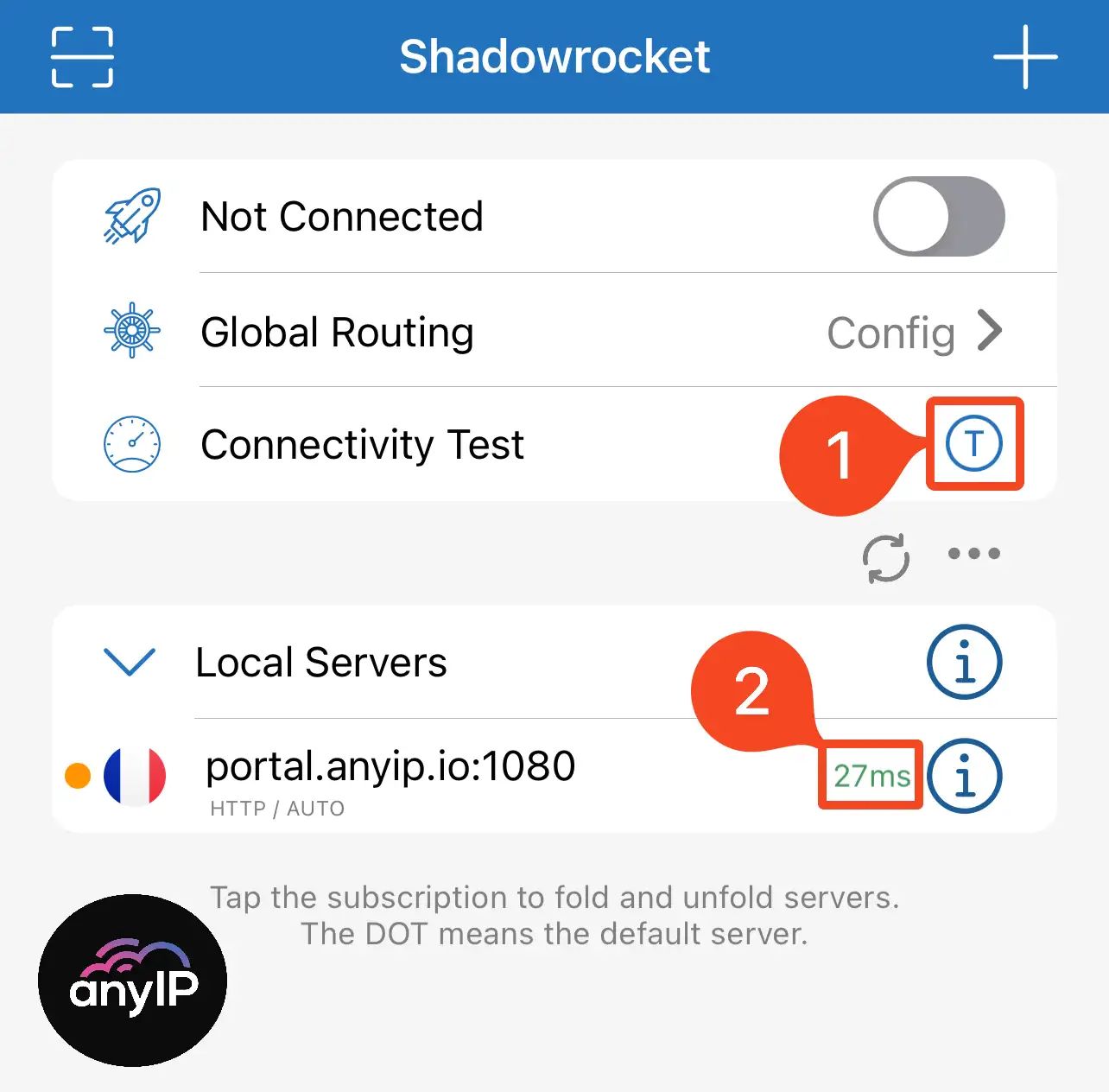
Shadowrocket gives you the option to run a quick connectivity test. In the main window:
Tap on the T icon to start the test.
You'll see the latency displayed next to your server profile.
That's a fast and easy way to spot a slow proxy.
Option 2: Third-party Test
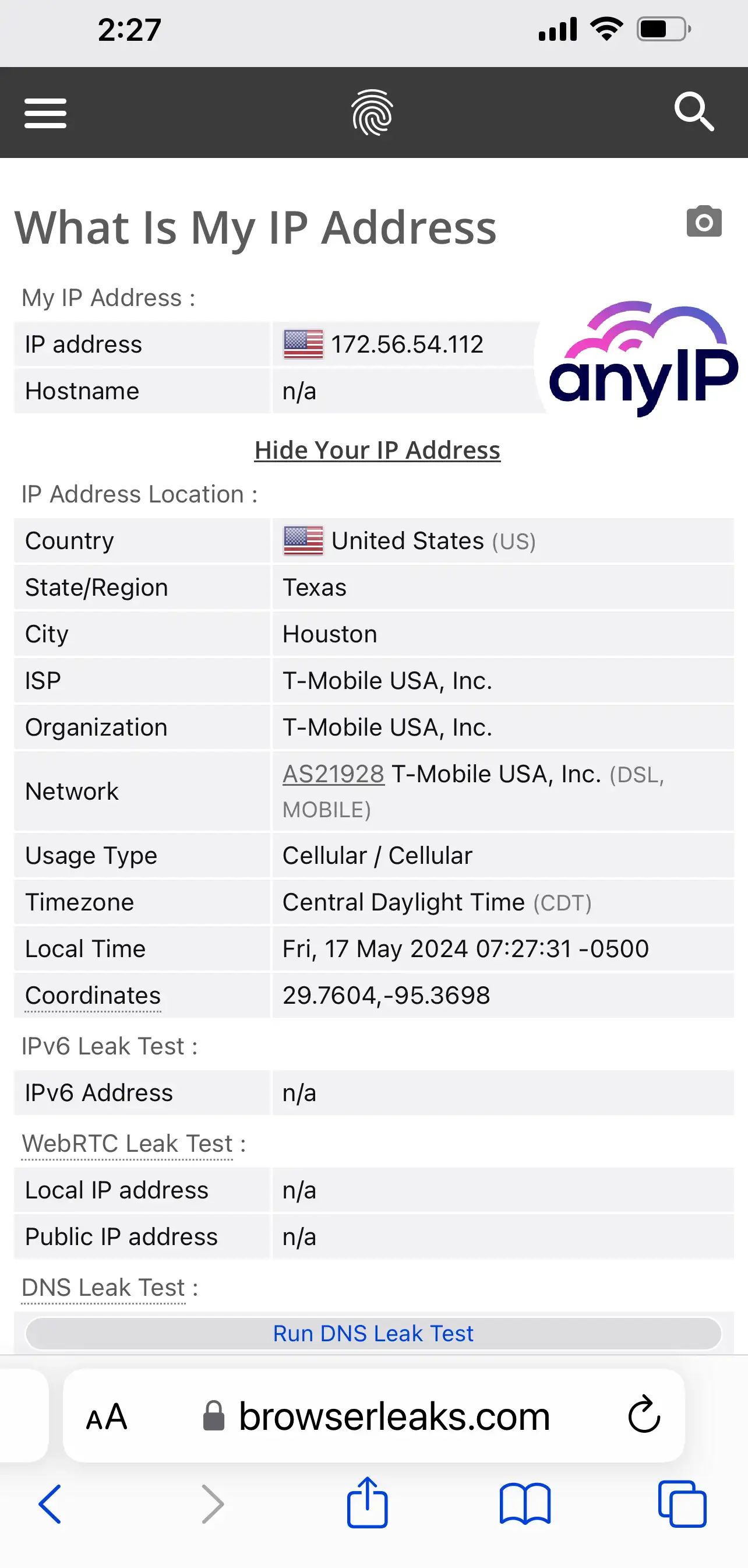
Alternatively, you can go to browserleaks to confirm your connection status. It’s a free tool that immediately shows your IP, location, ISP, network, usage, and even timezone.
What's a Proxy?
A proxy is like a middleman that stands between your iOS device and the end destination you’re trying to connect to. Regardless of what type of proxy you choose (residential, datacenter, shared, ISP, or mobile), all proxies will route your traffic through a different IP address, so websites and apps will see the IP of your proxy, but not your own.
There are 3 main types proxy protocol types – HTTP, HTTPS, and SOCKS5. Each one brings different benefits. To learn more, read our article about HTTP/HTTPS proxies.
Why Shadowrocket?
Configuring proxies on iOS devices is generally a straightforward process. However, if you want to set up multiple proxy profiles, you’ll find that iOS can only natively support one. That’s why users choose apps like Shadowrocket. Key features include:
Ease of use: The app has a simple and clean design, making it easy to navigate for beginners and experienced users.
Compatibility: Shadowrocket supports a list of different proxy protocols, allowing you to use and test different proxies.
Rule-based routing: Decide which domains, IP ranges, or countries go through the proxy and which connect directly.
Diagnostic tools: Shadowrocket provides tools to help track your proxy usage.
The only real consideration is that Shadowrocket is a paid app. However, it’s a relatively small investment compared to the features you get with this app.
Troubleshooting Common Issues
Shadowrocket is one of the best proxy management apps for iOS devices. However, some issues are bound to happen, and most are easy to fix once you identify the main problem.
DNS leak
A DNS leak occurs when your DNS requests aren't properly routed through the proxy, so they're sent directly to your ISP. This exposes your browsing activity, undermining the privacy that the proxy is meant to provide.
While anyIP effectively hides your IP address, if your system is not configured correctly, it may still route DNS requests outside of the proxy. Fortunately, this issue is easy to fix by adjusting your network settings to ensure all DNS traffic routes through the proxy, preserving your privacy and anonymity.
With Shadowrocket, the default network configuration can lead to a DNS leak. Here is how to quickly fix that:
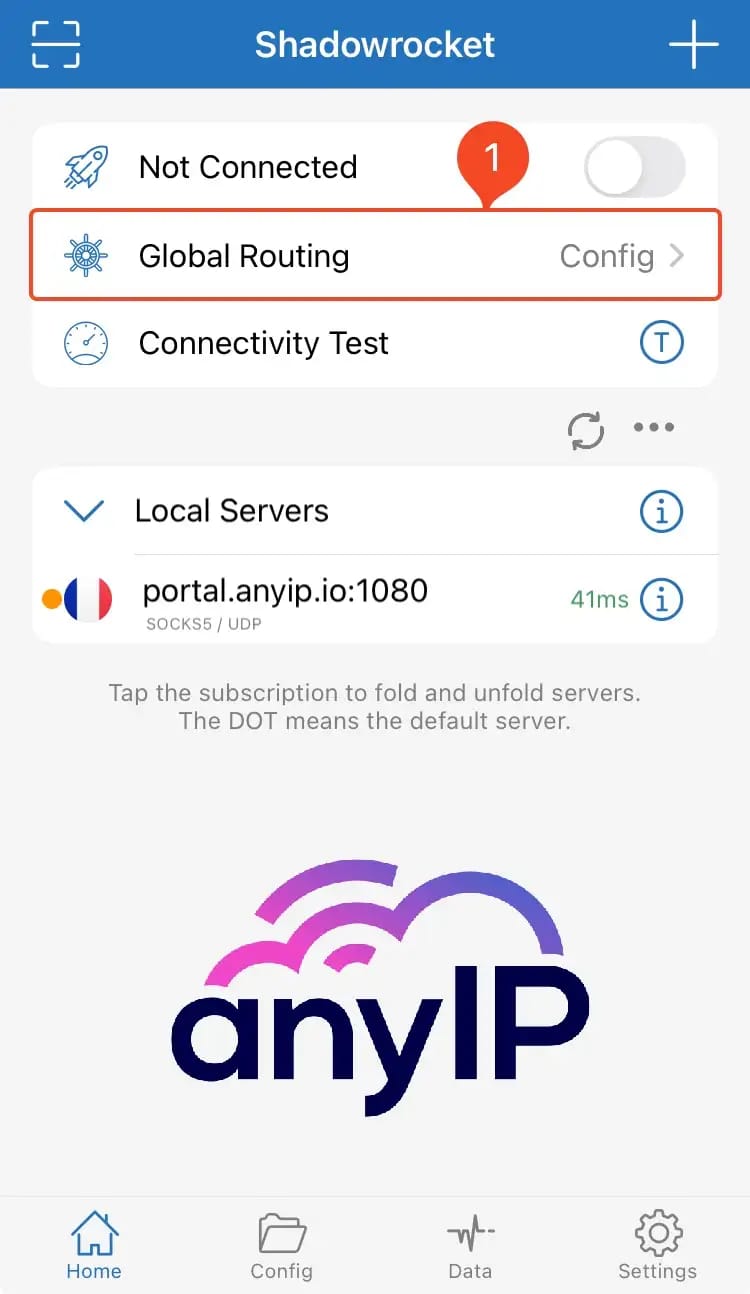
Open the Shadowrocket app and tap on Global Routing.
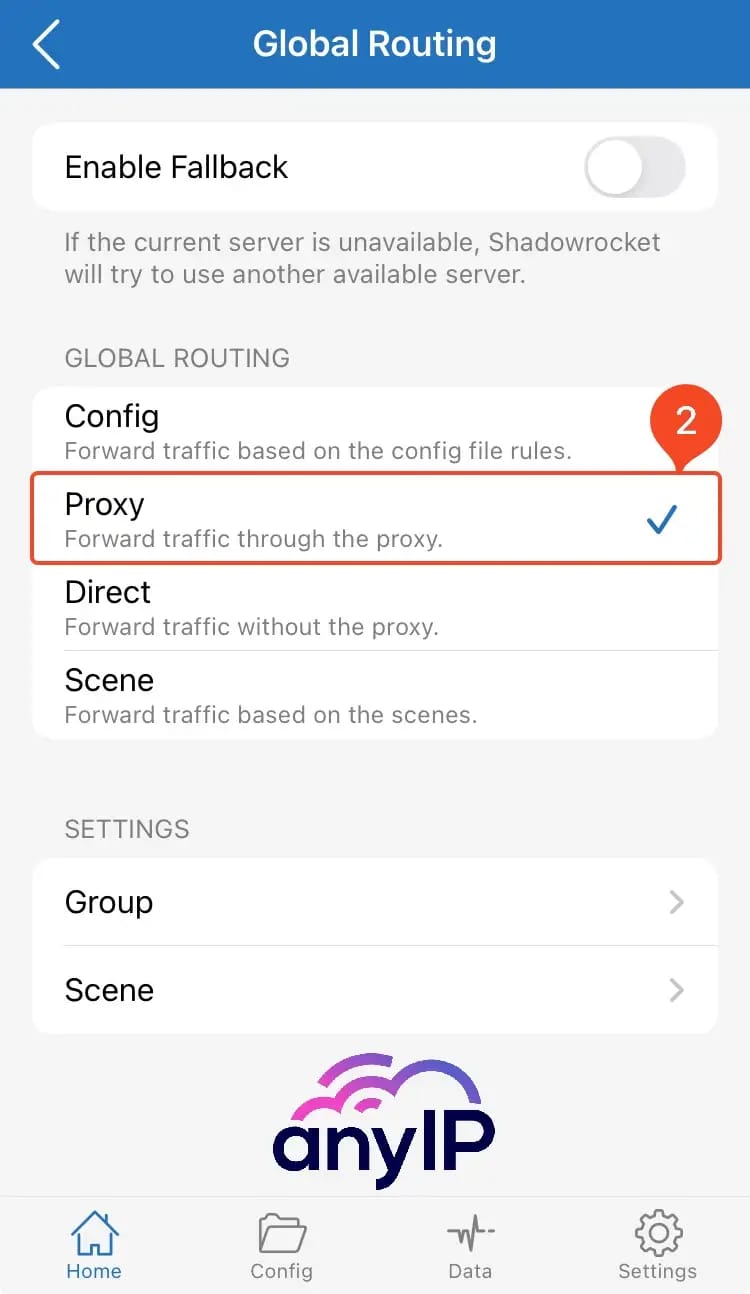
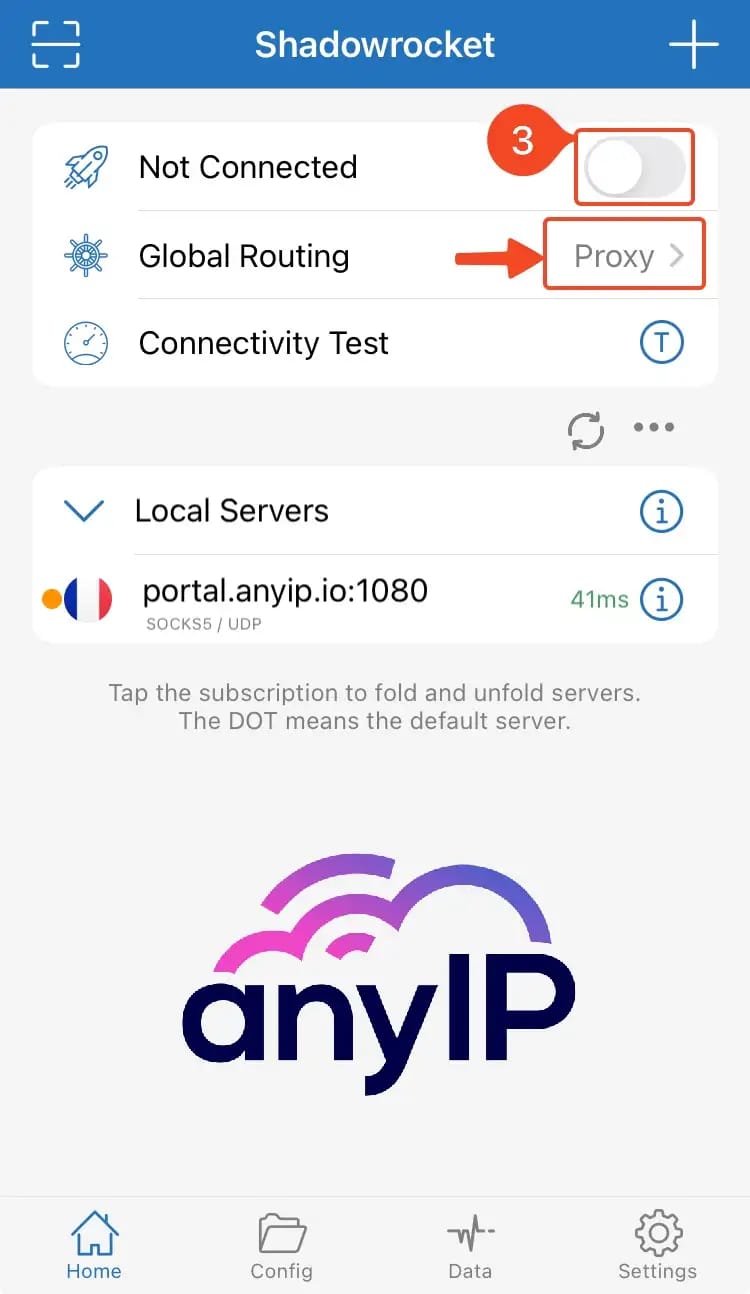
Select Proxy to forward all your traffic only through the proxy you configured.
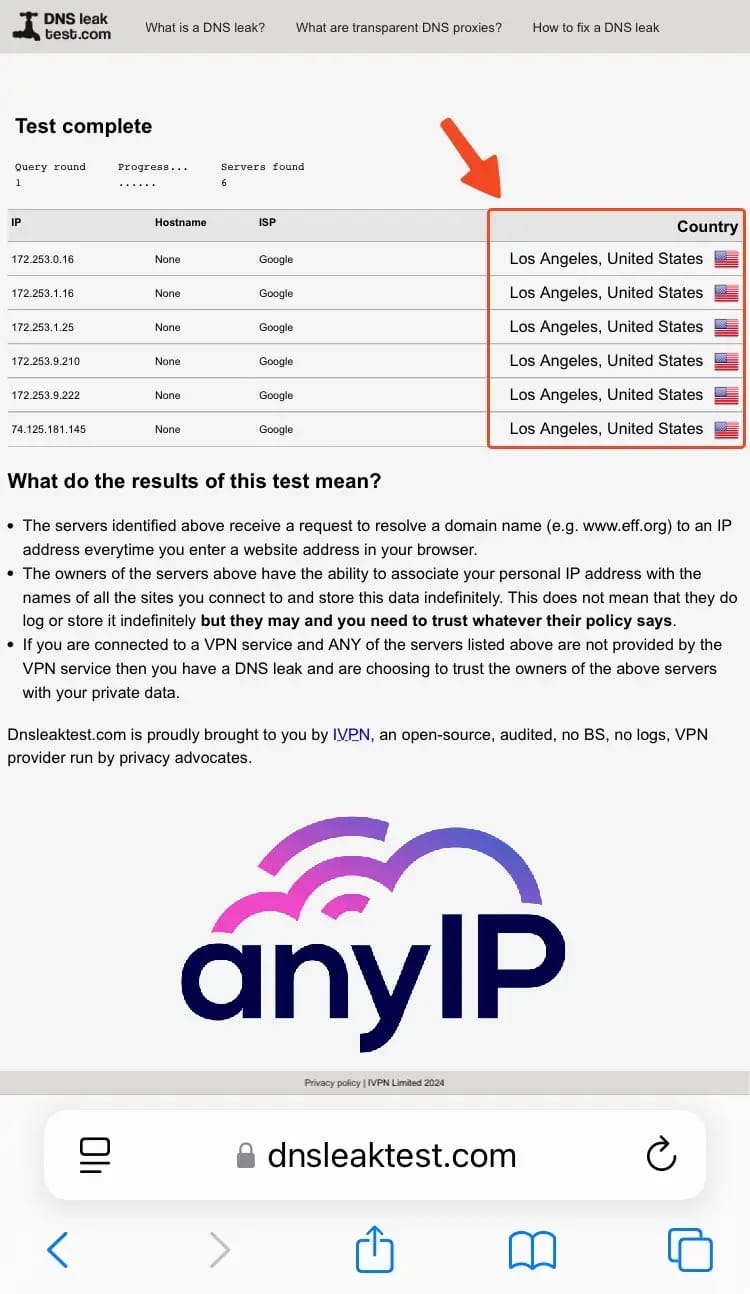
You can now run a quick online DNS leak test and see that your DNS servers are no longer exposed.
Connection refused or server not responding
This is one of the most common issues. First, confirm you entered the correct proxy credentials, especially if you entered them manually. However, if you find that the proxy information is correct, reach out to your proxy provider.
For anyIP users, you can quickly check the system uptime in real time by visiting https://status.anyIP.
Connected, but IP address hasn’t changed
Another common issue users face is when they see an active connection, but it still shows their real IP address. In this case, open your Shadowrocket app and tap on Global Routing and check that it's set to Proxy. Some traffic may be routed through your IP based on certain rules.
Make sure to turn off iCloud Private Relay (Settings > [your name] > iCloud > Private Relay), as it can override your proxy in Safari. Then, close the app and browser, and open both of them again. Run an additional connectivity test to see if your connection shows the IP of your proxy.
Proxy authentication error (e.g., HTTP 407)
If you get an HTTP 407 error message, it stands for Proxy Authentication Required. It means that the proxy server is active, but it doesn’t accept the proxy credentials you’ve provided. To fix this issue, go back to your anyIP dashboard and copy the credentials again.
Paste the information in the required fields and double-check that there are no additional symbols or spaces. Additionally, verify whether your account is active and that you still have data available.
Proxy works on Wi-Fi but not mobile data
Sometimes proxies may be active on Wi-Fi, but disconnect once you switch to mobile data. If this is the case for you, go to your iOS settings, tap on Mobile Data (or Cellular), and check whether Shadowrocket is allowed to use your mobile data.
As an extra step, check whether Low Data Mode is enabled, as it can restrict background connections. Keep in mind that some carriers block certain ports or proxy traffic, so you might need to change networks.
Shadowrocket won’t connect on iPhone
Typically, most issues are caused by a single typo during setup. Here’s a quick checklist you can go through to quickly check if your connection issues are caused by a typo:
Server and port: Make sure you’ve entered the right server and port without mixing up the fields.
Proxy type: Proxy protocol must be the same as your proxy’s.
VPN permission: You need to enable VPN configuration to use proxy management apps like Shadowrocket: Settings > General > VPN & Device Management > VPN.
Other VPNs: iOS only allows one VPN (this includes proxy apps) to be active at a time. If you’re using more than one, you’ll experience connectivity issues.
You can also tap Connectivity Test on the Shadowrocket home screen to check whether the proxy responds.
Slow connection
This issue is highly dependent on the kind of proxies you use and your carrier capabilities. For example, residential and mobile proxies are usually a little slower than shared or datacenter proxies because they route traffic through real devices. To improve your connection speed, you can:
Pick a proxy location close to you or to the website you're accessing.
Use sticky sessions instead of rotating IPs if possible.
Test your connection with the proxy turned off to rule out a slow network.
Check status.anyIP for any ongoing incidents.
Wrong country/location appears
If you notice a mismatch between the location shown by a website and your proxy, check if your country targeting is set correctly and turn off Location Services for your browser. This setting allows websites to use your GPS location. As a final note, you can also clear your browser cookies and cache.
Get a proxy now with anyIP
Sign up for an account on anyIP in just under 5 minutes to access a top-notch proxy service. anyIP offers a combined pool of high-quality 100M+ residential and mobile IP addresses from around the world.
If you’d like to learn more about anyIP or have any questions regarding our service, drop a message and our dedicated 24/7 support team will assist you as needed.
Frequently Asked Questions
Is Shadowrocket a VPN or a proxy?
Shadowrocket is a rule-based proxy management app for iOS. It’s not a VPN service, but it uses the iOS VPN framework to route traffic from your device through the proxy servers that you specify and configure. Conveniently, this app supports multiple proxy protocols and includes advanced settings to allow users to control which apps use proxy connections.
Does Shadowrocket include proxy servers?
No, Shadowrocket doesn’t provide proxy servers or a proxy subscription. It’s a proxy management app you can use together with a separate proxy subscription or service of your choice. You’ll need to set up a proxy server via the Shadowrocket app to start using proxies.
Why does Shadowrocket ask to add a VPN configuration?
iOS devices require a local VPN tunnel interface to check and intercept traffic through the proxy service you use as a security measure. However, Shadowrocket is a proxy management tool, and your iOS device sets up the VPN tunnel.
What does Global Routing mean in Shadowrocket?
Global Routing in Shadowrocket refers to the traffic routing feature of the app, and not to which proxy you want to use. Config follows your configured rules, Proxy routes traffic through the chosen proxy, and Direct bypasses the chosen proxy altogether.
Does Shadowrocket work on mobile data?
Yes, Shadowrocket supports mobile data. The app routes your mobile data traffic in the same way as your Wi-Fi traffic, based on your chosen proxy and Global Routing setting. Note that your carrier limits and network conditions all apply as normal.
Article by
Khaled Bentoumi
Khaled is a software engineer. He's been involved in many startups of different sizes. Previously, he founded Data to Page, an AI Programmatic SEO startup. He now handles all the marketing at anyIP.




Read more
How to Manage Proxies and Multiple Accounts in 2026: A Review of the Incogniton Antidetect Browser
Learn why pairing Incogniton with reliable proxies is the key to secure multi-account management, browser fingerprint protection, and safer automation in 2026.

How to customize Your User-Agent with Python Requests
Learn how to update and rotate user-agents in Python Requests to avoid detection and improve scraping efficiency.

How to Set Up a SOCKS5 Proxy in Chrome: Ultimate Guide
If you already use SOCKS5 proxies in other workflows, you might want to use them in your Google Chrome browser too. Unfortunately, Chrome can connect to SOCKS5 proxies but can't send a username and password.